The answer is rarely about effort. Most stalled companies are working harder than their growing competitors. The leadership team is capable. The market opportunity exists. The strategy makes sense on paper. And yet, year after year, the company remains roughly the same size, same revenue band, same team structure, more effort.
Growth stalls because of forces that operate underneath strategy. These forces are structural, not motivational. They’re not solved by working harder or wanting it more. They require specific interventions that address the underlying constraint.
There are four forces that pin companies at their current size. Each operates differently. Each requires a different response. And most companies have at least two of them active at once.
Structural Constraints: It’s Me, Not You
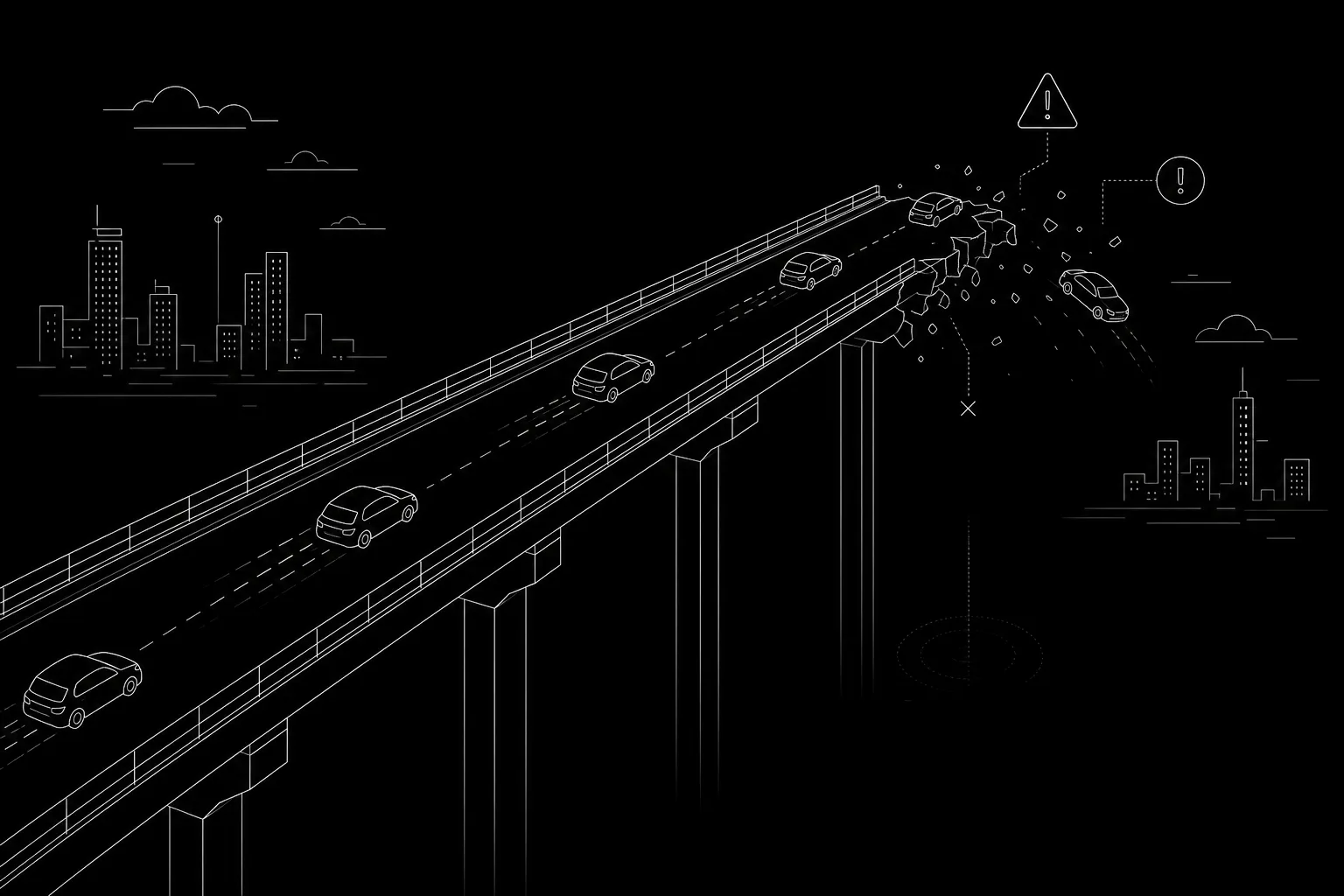
A structural constraint is a design decision that worked at one size but breaks at the next. It is not a problem to be solved — it is a foundation that needs to be rebuilt while the building is still occupied.
The most common structural constraint is founder dependency. At $500K in revenue, the founder can be involved in every client conversation, every hiring decision, every strategic choice. At $2M, that same involvement becomes the bottleneck. The company cannot grow faster than the founder can make decisions, and the founder cannot make decisions faster without sacrificing quality.
The constraint is not the founder’s capacity. It is the architecture that routes everything through one person.
Other structural constraints include:
- Revenue concentration — when 60% of revenue comes from three clients, growth requires either expanding those relationships (which has natural limits) or acquiring new clients at a rate that dilutes concentration (which is harder than it sounds)
- Delivery model dependency — when the business model assumes the founder or a specific senior person delivers the work, scaling requires either cloning that person (impossible) or redesigning what gets delivered (difficult and risky)
- Cash conversion cycle mismatch — when the business requires significant upfront investment in delivery before payment arrives, growth consumes cash faster than it generates it; the constraint is not profitability, it is timing
Structural constraints feel like operational problems. Leadership treats them as execution issues — “we just need to get better at this” — when they are actually architecture issues. You cannot execute your way out of a structural constraint. You have to redesign the structure.
The intervention is not incremental improvement. It is replacement. You build the new structure alongside the old one, migrate operations gradually, and retire the constraint once the new architecture is load-bearing.
Takeaway: Structural constraints are not problems to solve through better execution — they are foundations that must be rebuilt. Growth resumes when the new architecture can handle the load the old one could not.
Decision-Making Debt
Decision-making debt is the accumulation of choices that were deferred, avoided, or left ambiguous. It compounds over time. Each unmade decision creates downstream ambiguity, which creates more decisions, which creates more ambiguity.
At small scale, decision-making debt is manageable. The team is small enough that people can ask the founder directly. Context is shared. Ambiguity resolves through conversation.
At larger scale, decision-making debt becomes structural drag. New hires do not have the context to resolve ambiguity themselves. Middle managers escalate decisions upward because the boundaries of their authority were never defined. Projects stall waiting for clarity that never arrives because no one is sure who owns the decision.
The most expensive form of decision-making debt is strategic ambiguity. When the company has not decided what it is — what it sells, to whom, and why — every downstream decision becomes harder. Sales does not know which leads to prioritise. Marketing does not know what message to run. Product does not know what to build next. Everyone is working hard, but the work does not compound because there is no shared direction.
Decision-making debt also accumulates in:
- Organizational structure — when reporting lines, role boundaries, and decision rights are unclear, people spend more time negotiating territory than doing work
- Pricing and packaging — when the company has not decided what it charges or how it structures its offers, every deal becomes a negotiation from first principles
- Quality standards — when “good enough” has never been defined, teams either over-deliver (burning resources) or under-deliver (burning trust)
The intervention is not making every decision at once. It is identifying the decisions that are blocking the most downstream work and making those first. Decision-making debt is cleared in sequence, not in parallel.
The test of whether a decision has been made is whether people can act on it without asking permission. If they still escalate, the decision was not actually made — it was discussed.
Takeaway: Decision-making debt compounds when choices are deferred. Growth resumes when the decisions that block the most downstream work are made clearly enough that people can act without escalating.
Identity Lock-In: A Very Stale Story
Identity lock-in happens when the company’s self-concept — how it describes itself, what it believes it is good at, who it serves; gets misaligned with the market opportunity in front of it.
This is not about branding. It is about the internal story the company tells itself about what kind of company it is. That story shapes what opportunities the team sees, what work they pursue, and what capabilities they invest in building.
A consulting firm that sees itself as “the boutique option” will struggle to grow past a certain size because boutique-ness is part of the identity. Staying small is not a constraint — it is the point. Growth requires either abandoning the identity (and becoming something else) or redefining what boutique means at scale (which is harder than it sounds).
Identity lock-in shows up in several forms:
- Founder identity — when the company is inseparable from the founder’s personal brand, growth requires either cloning the founder (impossible) or building a brand that can exist independently (threatening to the founder’s sense of self)
- Category identity — when the company defines itself by what it does rather than the outcome it creates, it becomes trapped in a category that may be shrinking or commoditizing
- Client identity — when the company defines itself by who it serves rather than the problem it solves, it cannot expand into adjacent markets without feeling like it is abandoning its mission
The most dangerous form of identity lock-in is capability identity — when the company defines itself by what it is good at rather than what the market needs. “We are a design firm” is a capability identity. “We help companies make complex products simple” is an outcome identity. The first locks you into design. The second lets you use whatever capability the outcome requires.
Identity lock-in is resolved through redefinition, not abandonment. The company does not stop being itself — it expands the definition of what “itself” means. This is a narrative project, not an operational one. It requires the leadership team to articulate a new story that feels continuous with the old one but opens new territory.
The test is whether the new identity lets the team say yes to opportunities they would have previously declined without feeling like they are betraying the company’s core.
Capability Gaps: Absent Skills
A capability gap is the absence of a skill, process, or knowledge base that the next stage of growth requires. It is not about working harder with what you have — it is about needing something you do not currently possess.
Capability gaps are the most obvious of the four forces, but they are also the most commonly misdiagnosed. Leadership sees the gap and assumes the solution is hiring. Sometimes it is. Often it is not.
Hiring solves a capability gap only if:
- The capability can be isolated to a single role
- The company has the context and infrastructure to onboard someone with that capability
- The capability does not require deep integration with the founder’s or leadership team’s existing knowledge
If any of those conditions are false, hiring creates a new problem: a capable person in a role the company is not ready to support.
The most common capability gaps at growth inflection points are:
- Sales process design — the company has been growing through referrals and inbound interest, but the next stage requires outbound motion; the gap is not “someone who can sell,” it is “someone who can design a repeatable sales process”
- Financial planning — the company has been managing cash flow reactively, but the next stage requires forecasting, scenario planning, and capital allocation; the gap is not “someone who can do bookkeeping,” it is “someone who can model the business”
- Operational systems — the company has been coordinating work through direct communication, but the next stage requires documented processes, role clarity, and workflow design; the gap is not “someone who can manage projects,” it is “someone who can build systems”
Capability gaps are resolved through a combination of hiring, training, and process design. The intervention depends on whether the gap is in individual skill, organizational process, or institutional knowledge.
The test of whether a capability gap has been closed is whether the company can execute the capability repeatedly without heroic effort. If it still requires the founder or a specific person to step in and save it, the gap is still there.
Takeaway: Capability gaps are not always solved by hiring. The intervention depends on whether the gap is in individual skill, organizational process, or institutional knowledge. Growth resumes when the capability can be executed repeatedly without heroic effort.
How the Four Forces Interact
Most stalled companies have at least two of these forces active at once. The forces interact in predictable ways:
- Structural constraints create decision-making debt — when the architecture routes everything through the founder, decisions pile up waiting for the founder’s attention
- Identity lock-in prevents capability building — when the company defines itself narrowly, it does not invest in capabilities outside that definition
- Capability gaps create structural constraints — when the company lacks the skill to design a new process, it defaults to routing work through people who already know how to do it
The forces also mask each other. A company with a structural constraint will often diagnose the problem as a capability gap and hire someone to solve it. The new hire arrives, cannot operate within the constrained structure, and either leaves or becomes part of the constraint. Leadership concludes the hire was wrong when the actual problem was the structure.
The diagnostic question is: which force is primary? Which one, if addressed, would make the others easier to solve?
In most cases, the primary force is the one that has been true the longest. Structural constraints tend to predate the others. Identity lock-in tends to be older than capability gaps. Decision-making debt tends to be the most recent accumulation.
Start with the oldest force. It is usually load-bearing for the others.
Where to Start
If you are not sure which force is pinning your company, ask these questions:
- Structural constraint: Is there a part of the business that works well at current scale but would break if volume doubled? What is the bottleneck?
- Decision-making debt: What decisions are people escalating to leadership that they should be able to make themselves? What is unclear?
- Identity lock-in: If a lucrative opportunity appeared tomorrow that required the company to do something adjacent to its current work, would the team feel like it was a natural fit or a distraction?
- Capability gap: What does the next stage of growth require that no one on the current team knows how to do?
The force you can answer most clearly is usually the one to address first.
Growth does not resume because you want it more or work harder. It resumes when the force pinning the company at its current size is identified and addressed with the intervention that force requires. The companies that grow are not the ones with the best strategy — they’re the ones that see the constraint and rebuild around it.